
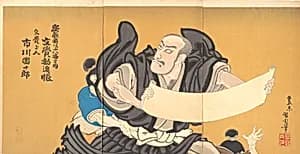
Ichikawa Danjūrō IX in the Role of the Monk Mongaku from the Play "Mongaku Kanjincho"
Medium
Triptych of woodblock prints; ink and color on paper
Dimensions
Vertical ōban; Image (each): 14 1/4 × 9 3/4 in. (36.2 × 24.8 cm)
Classification
Prints
Culture & Period
Japan · Meiji period (1868–1912)
Department
Asian Art
Museum
Metropolitan Museum of Art, New York, NY
Credit
Purchase, Jack Greene Gift, 2001
Accession Number
2001.715.2a–c
Rights
Public Domain
Tags
Art Historical Context
This vibrant triptych by Toyohara Kunichika captures kabuki superstar Ichikawa Danjūr IX in the dramatic role of the monk Mong from the play *Mongaku Kanjin*. Created in 1896 during Japan's Meiji period (1868–1912), the woodblock prints showcase Danjūrō's intense expression and flowing robes, rendered in bold ink and color on paper. Each vertical ōban sheet measures about 14¼ × 9¾ inches, combining seamlessly into a panoramic scene that heightens the theatrical tension. Kunichika, a leading ukiyo-e artist specializing in yakusha-e (actor prints), mastered dynamic poses and expressive faces to immortalize kabuki performers. This work reflects the golden age of Japanese theater, where stories like Mongaku's—drawn from legends of a warrior-monk's passionate redemption—drew massive audiences. Amid Meiji-era modernization, such prints preserved Edo-period traditions while blending Western influences in color and perspective. As a triptych, the format amplifies the epic scale of kabuki, a cultural cornerstone emphasizing mie (striking poses). Housed in the Metropolitan Museum of Art's Asian Art collection, it invites visitors to appreciate how woodblock printing democratized art, making star actors accessible to all.
About the Artist
Toyohara Kunichika · 1835–1900
Japanese, 1835–1900