
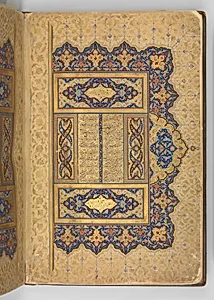
Illuminated Frontispiece of a Manuscript of the Mantiq al-Tayr (Language of the Birds)
text: dated A.H. 892/ 1487 CE; illumination: ca. 1600
Medium
Ink, opaque watercolor, silver, and gold on paper
Dimensions
H. 7 3/4 in. (19.7 cm) W. 4 1/2 in. (11.4 cm)
Classification
Codices
Department
Islamic Art
Museum
Metropolitan Museum of Art, New York, NY
Credit
Fletcher Fund, 1963
Accession Number
63.210.1
Rights
Public Domain
Art Historical Context
This exquisite illuminated frontispiece graces a manuscript of *Mantiq al-Tayr* (Language of Birds), the renowned 12th-century Sufiorical poem by Persian mystic Farid al-Din `Attar. The text was calligraphed in 1487 CE (A.H. 892) by masters Zain al-'Abidin al-Tabrizi and Sultan 'Ali al-Mashhadi, two of Timurid Iran's finest nasta'liq scribes, whose fluid, elegant script captures the poem's spiritual quest of birds seeking the divine Simurgh. Around 1600, during the Safavid era, lavish illumination was added, transforming the page into a radiant portal to Persian literary and mystical traditions. Crafted with ink, opaque watercolor, silver, and gold on paper (measuring just 7 3/4 x 4 1/2 inches), the frontispiece exemplifies Islamic codex artistry. Gold and silver accents create shimmering arabesques and floral motifs, a technique rooted in Timurid and Safavid illumination that symbolizes the ethereal "language of birds" as metaphor for divine enlightenment. Its compact codex format highlights the portability and reverence of Persian manuscripts, blending calligraphy, poetry, and decoration into a unified sacred object. Housed in the Metropolitan Museum of Art's Islamic Art Department (acquired via the Fletcher Fund in 1963), this work reveals the enduring cultural fusion of literature, spirituality, and opulent craftsmanship across centuries, inviting visitors to ponder `Attar's timeless wisdom: the soul's journey toward unity with the divine.