
Illuminated Opening Page Titled Laila and Majnun from a Khamsa (Quintet) of Nizami of Ganja
A.H. 835/ 1431–32 CE
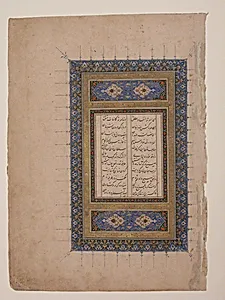
Medium
Ink, opaque watercolor, and gold on paper
Dimensions
Page: H. 12 5/16 in. (31.3 cm) W. 9 in. (22.9cm) Mat: H. 19 1/4 in. (48.9 cm) W. 14 1/4 in. (36.2 cm)
Classification
Codices
Department
Islamic Art
Museum
Metropolitan Museum of Art, New York, NY
Credit
Purchase, Lila Acheson Wallace Gift, 1994
Accession Number
1994.232.3
Rights
Public Domain
Art Historical Context
This exquisite illuminated page opens the tale of *Laila and Majnun* from Nizami of Ganja’s celebrated *Khamsa* (Quintet), a foundational work of Persian poetry completed in the late twelfth century. Created in 1431–32 the Timurid era, manuscript reflects the refined court culture of Herat, where literature, calligraphy, and painting flourished under princely patronage. The romantic story of star-crossed lovers Laila and Majnun, often compared to Romeo and Juliet, held deep emotional resonance across Persian-speaking lands and inspired generations of artists. Executed in ink, opaque watercolor, and gold on paper, the page exemplifies the luxurious codex tradition of Islamic art. Gold illumination frames the text with delicate floral and geometric motifs, while the elegant calligraphy—likely by the master scribe Ja’far Baisunghuri—demonstrates the refined nasta‘liq script prized in Timurid workshops. Such manuscripts were not merely books but objects of wonder, meant to be savored slowly by cultivated readers. Today housed in the Metropolitan Museum of Art’s Islamic Art department, this folio offers a vivid window into fifteenth-century Persian aesthetics and storytelling, where word and image combined to elevate a timeless tale of love and longing.
About the Artist
Ja'far Baisunghuri|Nizami (Iranian| ) · 1400 |1141 –1460 |1209
Iranian, active Herat, first half 15th century|present-day Azerbaijan, Ganja 1141–1209 Ganja