
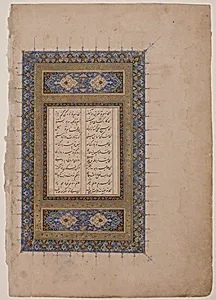
Illuminated Opening Page Titled Laila and Majnun from a Khamsa (Quintet) of Nizami of Ganja
dated A.H. 835/ 1431–32 CE
Medium
Ink, opaque watercolor, and gold on paper
Dimensions
Page: H. 12 5/16 in. (31.3 cm) W. 9 in. (22.9cm) Mat: H. 19 1/4 in. (48.9 cm) W. 14 1/4 in. (36.2 cm)
Classification
Codices
Department
Islamic Art
Museum
Metropolitan Museum of Art, New York, NY
Credit
Purchase, Lila Acheson Wallace Gift, 1994
Accession Number
1994.232.2
Rights
Public Domain
Tags
Art Historical Context
Welcome to the enchanting world of Timurid manuscript illumination! This stunning opening page, titled *Laila and Majnun* from Nizami of Ganja's *Khamsa* (Quintet), was created in 1431–32 CE by the skilled hand of Ja'far Baisunghuri. Nizami, a 12th-century Persian poet, composed the *Khamsa* as five epic masnavis, with *Laila and Majnun* telling the timeless tale of star-crossed lovers—often compared to Romeo and Juliet—in a blend of romance, mysticism, and Sufi allegory. Produced during the flourishing Timurid era in Persia, this page exemplifies the opulent book arts patronized by rulers like Shah Rukh. Crafted with ink, opaque watercolor, and gold on paper, the work showcases masterful calligraphy as its crowning feature, framed by intricate illumination. The opaque watercolors provide vibrant, jewel-like hues, while gold accents create a luminous effect, transforming the codex page into a visual poem. Measuring about 12½ by 9 inches, its delicate scale invites close contemplation, highlighting techniques that elevated manuscripts to treasures of Islamic art. Housed in the Metropolitan Museum of Art's Department of Islamic Art (purchase, Lila Acheson Wallace Gift, 1994), this artifact reveals the cultural pinnacle of 15th-century Persian scholarship and artistry, where text and image harmonized to inspire the soul.
About the Artist
Ja'far Baisunghuri|Nizami (Iranian| ) · 1400 |1141 –1460 |1209
Iranian, active Herat, first half 15th century|present-day Azerbaijan, Ganja 1141–1209 Ganja