
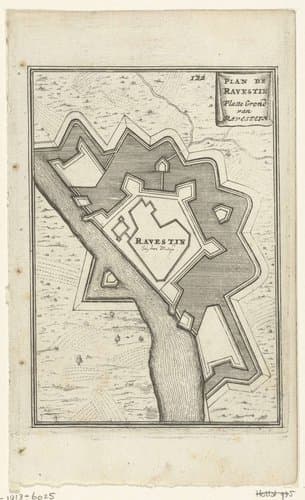
Illustratie voor 'Den Arbeid van Mars' van Allain Manesson Mallet
1672
Medium
etching
Dimensions
111; 184
Rights
Public Domain
About this artwork
ets en gravure
Art Historical Context
Romeyn de Hooghe, a prolific Dutch Baroque artist renowned for his intricate etchings and satirical works, created this illustration in 1672 for *Den Arbeid van Mars (The Labors of Mars) by Manesson Mallet. Measuring just 184 mm high by 111 mm wide, this etching captures the era's fascination with military engineering and fortification, themes central to Mallet's treatise on the "works of Mars," the Roman god of war. Produced during the turbulent Franco-Dutch War (1672–1678), it reflects Europe's intense focus on defensive architecture amid escalating conflicts. De Hooghe's mastery of etching—a technique involving acid-biting into metal plates for fine, expressive lines—shines here, blending technical precision with dramatic flair. The "ets en gravure" (etching and engraving) process allowed for detailed renderings of fortifications or battle scenes, making complex military concepts accessible. As a key figure in Dutch Golden Age printmaking, de Hooghe's illustrations elevated scholarly texts, bridging art and science for 17th-century audiences eager to understand the geometry of war. This small yet significant piece offers a window into Baroque-era innovation, where art documented the strategic "labors" shaping empires. Visitors will appreciate its historical snapshot of ingenuity under siege.
About the Artist
Romeyn de Hooghe · 1645–1708
Romeyn de Hooghe (1645-1708) was a Dutch Baroque engraver, draughtsman, and political satirist who became the most prolific and versatile graphic artist of the Dutch Republic in the late seventeenth century. Born in Amsterdam, he rose to become one of early modern Europe's most important printmakers and a pioneering master of political satire. De Hooghe's significance extends far beyond his techn...