
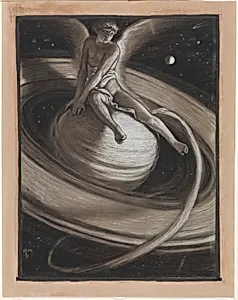
(Illustration for Rubáiyát of Omar Khayyám) The Throne of Saturn
1883-1884
Medium
Drawing
Classification
Drawing
Department
Smithsonian Collection
Museum
Smithsonian American Art Museum
Credit
Smithsonian American Art Museum, Museum purchase and gift from Elizabeth W. Henderson in memory of her husband Francis Tracy Henderson
Accession Number
1978.108.21
Rights
Public Domain
Tags
Art Historical Context
Elihu Vedder's *The Throne of Saturn* (1883–1884) is a captivating drawing created as part of his renowned series of illustrations for Edward FitzGerald's English translation of the *Rubiyát of Omar Khayyám*. This 11th-century Persian poet'satrains, blending philosophy, mysticism, and earthly pleasures, exploded in popularity in the Victorian era. Vedder, an American artist influenced by Pre-Raphaelite and Symbolist, produced 56 intricate drawings for a lavish 1884 edition, infusing the ancient verses with dreamlike, otherworldly imagery. Housed in the Smithsonian American Art Museum, this piece evokes the *Rubáiyát*'s cosmic contemplations on fate, time, and the universe. In the drawing, a majestic winged being presides over a planetary form symbolizing Saturn, masterfully rendered in Vedder's precise, flowing line work typical of his graphite, pen, and ink techniques. These drawings were groundbreaking for their fusion of Eastern motifs with Western Symbolism, elevating book illustration to fine art. Saturn, often linked to melancholy and eternity in mythology, resonates with Khayyám's themes of fleeting life amid celestial grandeur. Vedder's vision not only popularized the *Rubáiyát* across America but also bridged cultures, inspiring generations of artists. This Smithsonian treasure invites visitors to ponder the stars—and our place beneath them—through one man's poetic imagination. (198 words)
About the Artist
Elihu Vedder · 1836–1923
Elihu Vedder was born on February 26, 1836, in New York City to Dr. Elihu Vedder Sr., a dentist, and his cousin Elizabeth Vedder. As a young boy, his family relocated to Cuba for his father's ventures, an experience that sparked his artistic aspirations amid the Caribbean landscapes. He later divided his time between a boarding school and his maternal grandfather Alexander Vedder's home in Schenec...