
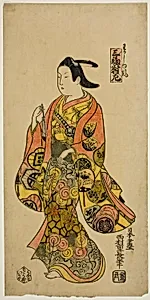
In the Style of a Young Man (Wakashu fu), Left Sheet of Triptych (Sanpukutsui hidari)
c. 1730
Medium
Hand-colored woodblock print; hosoban, urushi-e
Dimensions
33.1 × 16.2 cm (13 × 6 3/8 in.)
Classification
woodblock print
Department
Arts of Asia
Museum
Art Institute of Chicago
Accession Number
36352
Rights
Public Domain
Art Historical Context
Nishimura Shigenaga's *In the Style of a Young Man (Wakashu fu), Left Sheet of Triptych (Sanpukutsui hidari)*, created around 1730, captures the vibrant world of Edo-period Japan through a hand-colored woodblock print in the narrow hosoban format. Measuring just 33.1 × 16.2 cm, this intimate urushi-e—named for its glossy, lacquer-like sheen achieved with glue and pigment—exemplifies early ukiyo-e artistry. As the left panel of a triptych, it invites viewers to imagine its companions, forming a larger narrative scene typical of the "floating world" prints that celebrated urban pleasures. Shigenaga, a master of the Torii school tradition, specialized in yakusha-e (actor prints) and depictions of fashionable youths. Here, the wakashu—a stylish young man with flowing hair and elegant robes—embodies the androgynous allure popular in kabuki theater culture. These figures blurred gender lines, appealing to diverse audiences amid Japan's Genroku-era fascination with beauty and transience. The urushi-e technique, predating full-color nishiki-e, highlights Shigenaga's skill in subtle hand-coloring and bold lines, making this print a gem of transitional ukiyo-e. Housed in the Art Institute of Chicago's Arts of Asia collection, it offers a window into 18th-century Tokyo's playful, hedonistic spirit.
About the Artist
Nishimura Shigenaga · 1690–1758
Nishimura Shigenaga (c. 1697–1756) was a pioneering Japanese ukiyo-e printmaker born in Edo (modern-day Tokyo), where he initially worked as a landlord in the Tōriabura-chō district before relocating to Kanda-Sakumachō to operate a bookshop. Self-taught with no known formal teacher, he immersed himself in art around 1719, drawing early inspiration from the Torii school's yakusha-e (actor portraits...