
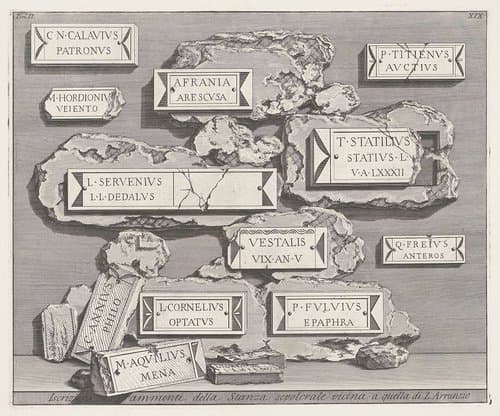
Inscripties en fragmenten uit een grafkelder
c. 1756 - c. 1757
Medium
etching
Dimensions
48; 395
Rights
Public Domain
About this artwork
ets
Art Historical Context
**Inscripties en fragmenten uit een grafkel** (Inscriptions and Fragments from a Tomb Vault), an etching by Giovanni Battista Pir from around 1756–1757, captures the intricate details of ancient Roman funerary artifacts. Piranesi, a masterful Venetian-born artist and architect active in Rome, was renowned for his dramatic etchings that romanticized the ruins of antiquity. This tall, narrow plate (395 × 48 mm) likely belongs to his series *Le Antichità Rom* or related works on sepulchral monuments, where he meticulously documented crumbling inscriptions and stone fragments from underground tombs, evoking the grandeur and melancholy of imperial Rome. Etching, Piranesi's preferred medium, allowed him to achieve extraordinary depth and texture through acid-bitten lines on copper plates, producing rich, shadowy contrasts that mimic the dim light of burial chambers. His vedutista style—blending precise topography with imaginative flairbridged archaeology and art, influencing the Neoclassical movement and Grand Tour travelers who sought inspiration from Rome's past. This work highlights Piranesi's passion for preserving classical heritage amid 18th-century rediscoveries, offering visitors a window into the solemn rituals of ancient Roman death and the enduring allure of its decayed splendor. A testament to his technical virtuosity, it invites us to ponder the whispers of history etched in stone.
About the Artist
Giovanni Battista Piranesi · 1720–1778
Giovanni Battista Piranesi (1720–1778) was an Italian printmaker, architect, and antiquarian whose visionary etchings of Rome and imaginary prisons revolutionized architectural representation and profoundly influenced both Neoclassicism and Romanticism. Piranesi stands as one of the most important printmakers of the eighteenth century, fundamentally shaping European perceptions of ancient Rome an...