
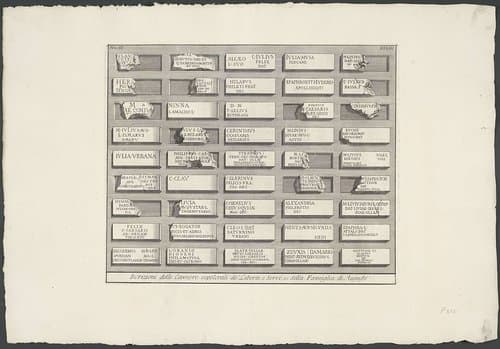
Iscrizioni delle Camere sepolcrali de' Liberti e Servi, ec della Famiglia di Augusto
ca. 1756 - ca. 1757
Medium
etching
Dimensions
395; 479
Rights
Public Domain
About this artwork
height 395 mm x width 479 mm
Art Historical Context
Giovanni Battista Piranesi, the visionary 18th-century Italian artist and architect, created *Iscrizioni delle Cam sepolcrali de' Liberti e Servi, ec della Famiglia di Augusto* around 1756–1757. This striking etching, measuring 395 mm by 479 mm, meticulously documents ancient Roman inscriptions from the sepulchral chambers of freedmen, servants, and members of Emperor Augustus's family. Piranesi, renowned for his dramatic vedute and archaeological prints, used this work to preserve fading Roman antiquities amid the ruins of Rome. The artwork holds immense historical value as a window into the daily lives and social structures of the early Roman Empire. These inscriptions, likely from tombs along the Via Appia, reveal the status and legacies of Augustus's household—freed slaves who rose to prominence in the imperial circle. Piranesi's passion for antiquity drove him to record such ephemera, safeguarding epigraphic evidence that might otherwise be lost to time and decay. Artistically, the etching showcases Piranesi's masterful technique: intricate line work and shadowy depths that evoke the grandeur and melancholy of ancient Rome. His Baroque-influenced style blends precision with romantic drama, making this print not just a scholarly record, but a captivating invitation to explore Rome's layered past.
About the Artist
Giovanni Battista Piranesi · 1720–1778
Giovanni Battista Piranesi (1720–1778) was an Italian printmaker, architect, and antiquarian whose visionary etchings of Rome and imaginary prisons revolutionized architectural representation and profoundly influenced both Neoclassicism and Romanticism. Piranesi stands as one of the most important printmakers of the eighteenth century, fundamentally shaping European perceptions of ancient Rome an...