
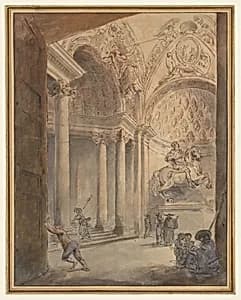
Interior of Saint Peter's
ca. 1758
Medium
Pen and black ink over blue, green, and rose watercolor, gray and brown wash with red chalk underdrawing.
Dimensions
16 3/16 x 12 5/8 in. (41.1 x 32.1 cm)
Classification
Drawings
Department
Robert Lehman Collection
Museum
Metropolitan Museum of Art, New York, NY
Credit
Robert Lehman Collection, 1975
Accession Number
1975.1.694
Rights
Public Domain
Tags
Art Historical Context
Step into the awe-inspiring vastness of Saint Peter's Basilica Hubert Robert's *Interior of Saint Peter's* (ca. 1758), a masterful drawing that captures the basilica's soaring architecture and sculptural splendor. French artist Hubert Robert, often called "Robert desines," created this during his formative years in Rome (1755–1765), where he immersed himself in the city's ancient and Baroque wonders as a Prix de Rome winner. His neoclassical style, blending precise observation with imaginative flair, transforms the Vatican's iconic interior—pilasters, domes, and monumental sculptures—into a luminous vision of grandeur and spirituality. Crafted with pen and black ink over delicate blue, green, and rose watercolors, accented by gray and brown washes and red chalk underdrawing, the work showcases Robert's virtuoso technique. This mixed-media approach allowed for atmospheric depth and subtle color harmonies, evoking the play of light filtering through the basilica's immense spaces. As a drawing from the Robert Lehman Collection at The Metropolitan Museum of Art, it exemplifies 18th-century veduta artistry, bridging tourism sketches and grand painting preparations. Robert's evocative rendering not only documents a pinnacle of Renaissance and Baroque engineering but also reflects the Grand Tour era's fascination with Italy, inviting viewers to ponder the eternal dialogue between human ambition and divine space. (198 words)
About the Artist
Hubert Robert · 1733–1808
Hubert Robert, born on May 22, 1733, in Paris, emerged from a modest background; his father, Nicolas Robert, served the influential Choiseul family, whose patronage shaped the young artist's path. After completing his studies at the Jesuit Collège de Navarre in 1751, he entered the atelier of sculptor Michel-Ange Slodtz, who taught him design and perspective before encouraging a shift to painting....