
View of the Campidoglio with the Statue of Marcus Aurelius
1762
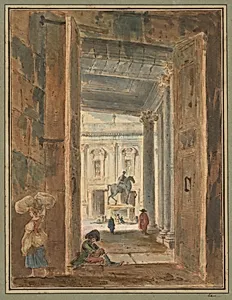
Medium
Pen and black ink, brush and watercolor over red chalk counterproof.
Dimensions
17 1/4 x 13 1/8 in. (43.8 x 33.4 cm)
Classification
Drawings
Department
Robert Lehman Collection
Museum
Metropolitan Museum of Art, New York, NY
Credit
Robert Lehman Collection, 1975
Accession Number
1975.1.695
Rights
Public Domain
Tags
Art Historical Context
Step into the sunlit grandeur of Rome's Capitoline through Hubert Robert's *View of the Campid with the Statue of Marcuslius* (1762). This drawing captures the heart of the Campidoglio piazza, designed by Michelangelo, with the ancient bronze equestrian statue of Emperor Marcus Aurelius as its focal point—a Roman treasure from the 2nd AD, long admired by Grand Tour travelers. Created during Robert's formative years in Rome (175–64), it reflects the French artist's deep fascination with antiquity, earning him the nickname "Robert des Ruines" for his evocative depictions of classical architecture. Robert, a master of the veduta tradition blending neoclassicism and romanticism, populates the scene with human figures, sculpted details, and ornate doors, infusing the timeless ruins with life and movement. The work's historical significance lies in its snapshot of 18th-century Rome, a hub of artistic pilgrimage where ruins symbolized the enduring legacy of empire amid Baroque splendor. Executed in pen and black ink, brush and watercolor over red chalk counterproof—a technique that produced a reversed impression for refinement without smudging—the 17¼ × 13⅛-inch sheet showcases Robert's virtuoso handling of light and texture. Housed in the Metropolitan Museum of Art's Robert Lehman Collection, this drawing invites us to ponder Rome's layered past, bridging ancient glory and Enlightenment curiosity.
About the Artist
Hubert Robert · 1733–1808
Hubert Robert, born on May 22, 1733, in Paris, emerged from a modest background; his father, Nicolas Robert, served the influential Choiseul family, whose patronage shaped the young artist's path. After completing his studies at the Jesuit Collège de Navarre in 1751, he entered the atelier of sculptor Michel-Ange Slodtz, who taught him design and perspective before encouraging a shift to painting....