
James Smithson
Medium
Painting
Classification
Painting
Department
Smithsonian Collection
Museum
Smithsonian American Art Museum
Credit
National Portrait Gallery, Smithsonian Institution; transfer from the National Museum of American History Conserved with funds from the Smithsonian Women's Committee
Accession Number
NPG.85.44
Rights
Public Domain
Tags
About this artwork
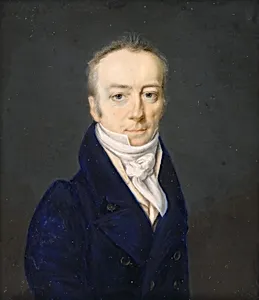
This miniature portrait portrays British scientist James Smithson (c. 1765–1829), the Smithsonian Institution’s founding patron. Smithson left his fortune to the U.S. government to establish an institution “for the increase & diffusion of knowledge among men.” Smithson was born out of wedlock to a duke, who refused to recognize his son in a society oriented around pedigree. Although Smithson never visited the United States, he admired its democratic ideals.
Art Historical Context
This miniature portrait, painted in 1816 by Henri-Joseph Johns, captures British scientist James Smithson, the founding patron of the Smithsonian Institution. As a compact, intimate format popular in the early nineteenth century, the miniature allowed for personal keepsakes that traveled easily, reflecting the era’s emphasis on individual legacy amid expanding global connections. Smithson, born around 1765 out of wedlock to a duke who never acknowledged him, pursued a distinguished career as a chemist despite societal barriers tied to pedigree. He never visited the United States yet admired its democratic principles, ultimately bequeathing his fortune in 1829 to establish an institution “for the increase & diffusion of knowledge among men.” The painting’s presence in the Smithsonian’s National Portrait Gallery underscores this remarkable transatlantic gift. Today the work serves as a quiet emblem of curiosity and generosity, inviting visitors to reflect on how one individual’s vision transformed into a national treasure trove of learning.