
Jean Marie Soulier
Medium
Classification
Department
Smithsonian Collection
Museum
Smithsonian American Art Museum
Credit
National Portrait Gallery, Smithsonian Institution; gift of Mr. and Mrs. Paul Mellon
Accession Number
S/NPG.74.39.7.48
Rights
Public Domain
Tags
Art Historical Context
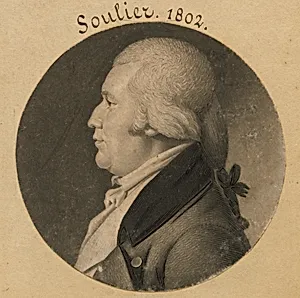
This elegant 1802 print portrays Jean Marie Soulier, a male subject captured in profile by the French-born artist Charles Balthazar Julien Fret de Saint-Mé (1770–1852). Saint-Mémin, who fled the French Revolution and settled in America, specialized in precise portrait prints that documented the early republic's diverse citizens—from statesmen to merchants. Produced during a time when photography was decades away, these works offered an accessible alternative to costly oil paintings, making portraiture available to the middle class. Saint-Mémin's innovative technique involved the physiognotrace, a mechanical device that traced profiles onto paper, which he then engraved and hand-colored for striking realism. This print, now in the Smithsonian American Art Museum's collection (gift of Mr. and Mrs. Paul Mellon), exemplifies his mastery of line and subtle shading, creating intimate vignettes of identity. Its survival in the National Portrait Gallery underscores its role in preserving personal stories from the early 1800s. As a cultural artifact, the portrait reflects the transatlantic exchanges of the era, blending European artistry with American optimism. Visitors will appreciate how Soulier's poised silhouette evokes the formality of post-Revolutionary society, inviting us to ponder his untold story amid a nation's unfolding narrative.