
Jewish Quarters in Amsterdam
1826 to 1850
Medium
wood engraving
Classification
Department
CG-E
Museum
National Gallery of Art, Washington, D.C.
Credit
Rosenwald Collection
Accession Number
1943.3.5549
Rights
Public Domain
Art Historical Context
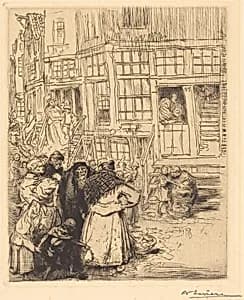
**Jewish Quarters in Amsterdam** Auguste Lepère invites visitors into the vibrant streets of 19th-century Amsterdam through the delicate art of wood engraving. Created between 1826 and1850, this print the National Gallery of Art Rosenwald Collection captures the essence of the city's historic Jewish quarters, a neighborhood long renowned for its cultural and commercial vitality. Wood engraving, Lepère's chosen medium, exemplifies a precise 19th-century technique where artists carved fine lines into end-grain wood blocks for sharp, detailed reproductions. This allowed intricate depictions of architecture, crowds, and daily life to reach broad audiences via affordable prints, bridging fine art and popular illustration. As part of the CG-E Department’s print collection, the work highlights Amsterdam’s Jodenbuurt—a hub of Jewish heritage amid the Netherlands' tolerant Golden Age legacy. Lepère’s composition draws viewers into a world of narrow alleys and communal energy, offering a poignant window into urban diversity and resilience.
About the Artist
Auguste Lepère · 1849–1918
Auguste-Louis Lepère (1849–1918), son of the sculptor François Lepère, was born in Paris on November 30, 1849, into an artistic family that shaped his early path. At age thirteen, he apprenticed in the Paris studio of the English wood engraver Joseph Burn Smeeton, honing his skills in wood engraving until 1867. He furthered his training with drawing classes under Horace Lecoq de Boisbaudran at the...