
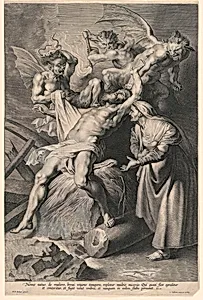
Job Tormented by the Demons and His Wife
ca. 1630-1650
Classification
Department
Smithsonian Collection
Museum
Smithsonian American Art Museum
Credit
Smithsonian American Art Museum
Accession Number
1957-41-26
Rights
Public Domain
About this artwork
Research in Progress
Art Historical Context
**Job Tormented by the Demons and His Wife** *Lucas Vorsterman (Flemish, 1595–1675), ca. 1630–1650* Print, Smithsonian American Art Museum This striking print by Flemish engraver Lucas Vorsterman captures a dramatic moment from the Book of Job in the Bible, where the righteous Job endures torment from demons while his wife urges him to curse God and die (Job 2:9). Created around 1630–1650 during the Baroque era, it reflects the intense emotional and spiritual themes popular in Flemish art, emphasizing faith amid suffering. Vorsterman, a master printmaker based in Antwerp, was renowned for his precise engravings that reproduced paintings by contemporaries like Peter Paul Rubens, making grand religious narratives accessible to a wider audience. As a print, the work highlights the revolutionary role of engraving in 17th-century Europe: it allowed intricate details—twisted demonic forms, Job's stoic endurance, and expressive gestures—to be mass-produced and shared across households and churches. Vorsterman's technique likely employed fine lines and rich tonal contrasts, hallmarks of Flemish Baroque printmaking, to evoke pathos and divine mystery. Though research continues, this piece exemplifies how prints bridged elite art and popular devotion, preserving biblical stories for generations. Housed in the Smithsonian American Art Museum's collection, it invites visitors to ponder timeless questions of resilience and piety through Vorsterman's masterful lens. (198 words)