
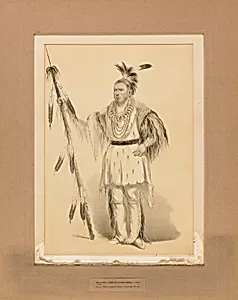
Joc-o-sot--no. 26
Medium
Graphic Arts-Print
Classification
Graphic Arts-Print
Department
Smithsonian Collection
Museum
Smithsonian American Art Museum
Credit
Smithsonian American Art Museum, Transfer from the National Museum of Natural History, Department of Ethnology, Smithsonian Institution
Accession Number
1985.66.386,590V
Rights
Public Domain
Tags
Art Historical Context
George Catlin, a pioneering 19th-century American artist dedicated much of his career to documenting the lives and likenesses of Native American peoples creating over 600 portraits during his travels across the Great Plains in the 1830s. *Joc-o-sot—no. 26*, a arts print from the Smithsonian American Art Museum exemplifies this mission. Likely part of Catlin's extensive series of Native American subjects—tagged simply as "Indian" and "full length"—it captures a figure in poised, ethnographic detail, preserving cultural identities amid rapid Western expansion. As a print medium, this work's significance lies in its reproducibility, allowing Catlin's vivid observations to reach broader audiences beyond his original oil paintings. Transferred from the National Museum of Natural History's Department of Ethnology, it underscores the artwork's dual role as fine art and anthropological record. Catlin's realistic style, influenced by Romanticism, emphasized dignity and individuality, countering stereotypes and offering an early visual archive of vanishing traditions. Though the exact date remains unknown, *Joc-o-sot—no. 26* invites visitors to reflect on America's indigenous heritage, blending artistic innovation with historical urgency in the Smithsonian's esteemed collection.
About the Artist
George Catlin · 1796–1872
George Catlin (1796–1872), born in Wilkes-Barre, Pennsylvania, to Putnam Catlin and Polly Sutton—who had been captured by Native Americans during the 1778 Battle of Wyoming—initially pursued a legal career. Trained at Litchfield Law School, he was admitted to the bar in 1819 but abandoned law after two years to study art in Philadelphia in 1823. Self-taught as a portraitist, Catlin quickly gained ...