
Joc-o-sot, the Walking Bear
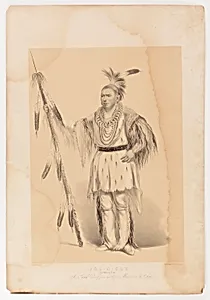
Medium
Graphic Arts-Print
Classification
Graphic Arts-Print
Department
Smithsonian Collection
Museum
Smithsonian American Art Museum
Credit
Smithsonian American Art Museum, Transfer from the National Museum of Natural History, Department of Ethnology, Smithsonian Institution
Accession Number
1985.66.386,592Z
Rights
Public Domain
Tags
Art Historical Context
**Joc-o-sot, the Walking Bear** is a striking full-length print by George Catlin, the pioneering 19th-century American renowned for his vivid documentation of Native American life. Catlin journeyed across the Great Plains in the 1830s, painting hundreds of portraits and scenes to capture Indigenous cultures he feared were on the brink of disappearance due to westward expansion and U.S. policies. This graphic arts print, housed in the Smithsonian American Art, likely reproduces one of his original oil portraits, showcasing his commitment to authenticity amid a rapidly changing American frontier. The subject, Joc-o-sot (also known as the "Walking Bear"), was a prominent Sauk warrior whose image Catlin immortalized during his travels. Tagged simply as "Indian," the work embodies Catlin's ethnographic focus, presenting the figure in traditional attire with a dignified, poised stance that highlights cultural pride and physical prowess. As a print medium, it allowed wider dissemination of Catlin's observations, bridging art and anthropology for 19th-century audiences hungry for glimpses of the "noble savage." This piece holds enduring historical significance, offering a window into pre-reservation Native American identity while sparking debates on artistic representation. Transferred from the National Museum of Natural History, it reminds us of Catlin's dual role as artist and advocate, preserving stories that might otherwise be lost. (198 words)
About the Artist
George Catlin · 1796–1872
George Catlin (1796–1872), born in Wilkes-Barre, Pennsylvania, to Putnam Catlin and Polly Sutton—who had been captured by Native Americans during the 1778 Battle of Wyoming—initially pursued a legal career. Trained at Litchfield Law School, he was admitted to the bar in 1819 but abandoned law after two years to study art in Philadelphia in 1823. Self-taught as a portraitist, Catlin quickly gained ...