
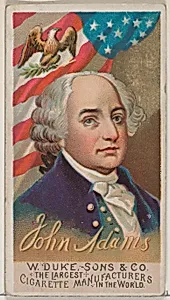
John Adams, from the series Great Americans (N76) for Duke brand cigarettes
Medium
Commercial color lithograph
Dimensions
Sheet: 2 3/4 × 1 1/2 in. (7 × 3.8 cm)
Classification
Prints|Ephemera
Department
Drawings and Prints
Museum
Metropolitan Museum of Art, New York, NY
Credit
The Jefferson R. Burdick Collection, Gift of Jefferson R. Burdick
Accession Number
63.350.204.76.1
Rights
Public Domain
Tags
Art Historical Context
This charming chromolithograph features John Adams, the second President of the United States, as part of the "Great Americans (N76)" series produced by W. Duke, Sons & Co. in 1888. These tiny cards (just 2¾ × 1½ inches) were tucked into Duke cigarette packs as promotional inserts, a clever marketing tactic to engage smokers and spark collecting fervor. By honoring Founding Fathers like Adams, the series blended patriotism with commerce, turning everyday tobacco products into pocket-sized history lessons during America's Gilded Age. The medium—commercial color lithography—allowed for vibrant, mass-produced portraits with striking details, from Adams' stern gaze to his period attire. Chromolithography's efficiency made such ephemera affordable and widespread, reflecting the era's booming advertising industry and the rise of consumer culture. Cigarette cards like this one fueled a massive hobby, with collectors trading sets on heroes, sports figures, and more. Preserved in the Metropolitan Museum of Art's Jefferson R. Burdick Collection, this print highlights the artistry in overlooked objects. It reminds us how 19th-century commerce immortalized national icons, bridging history and everyday life in a single, colorful keepsake.
About the Artist
W. Duke, Sons & Co. · 1870–1920
**W. Duke, Sons & Co.: Pioneers of Chromolithographic Trade Card Art** W. Duke, Sons & Co., an American tobacco manufacturer, emerged from the entrepreneurial vision of Washington Duke (1820–1905) and his sons in Durham, North Carolina. After the Civil War, Washington abandoned farming in 1874 to join his eldest son, Brodie L. Duke, in the burgeoning tobacco trade, establishing a factory that for...