
John Chew Thomas
Medium
Classification
Department
Smithsonian Collection
Museum
Smithsonian American Art Museum
Credit
National Portrait Gallery, Smithsonian Institution; gift of Mr. and Mrs. Paul Mellon
Accession Number
S/NPG.74.39.11.5
Rights
Public Domain
Tags
Art Historical Context
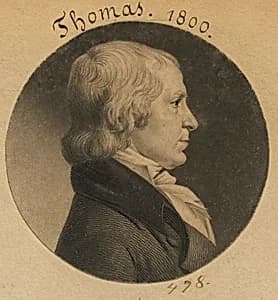
In the National Portrait Gallery's collection at the Smithsonian American Art Museum this elegant 1800 print captures John Chew Thomas, prominent Maryland lawyer and statesman during the early years of the American republic. Created by French émigré artist Charles Balthazar Julienévret de Saint-Mmin (1770–1852), the portrait exemplifies the artist's innovative profile style, which became a hallmark of Federal-era portraiture. Saint-Mémin, fleeing the French Revolution, arrived in Philadelphia in 1793 and quickly adapted to American tastes, producing thousands of such likenesses for the emerging nation's elite. Saint-Mémin's technique was groundbreaking: he used a mechanical device called a physiognotrace to trace a sitter's silhouette with pinpoint accuracy, then engraved it in fine stipple for mass reproduction as small, affordable prints. This print medium democratized portraiture, allowing middle- and upper-class Americans to own images of notable figures like Thomas, who served in Congress and embodied the legal and political fabric of post-Revolutionary Maryland. A gift from Mr. and Mrs. Paul Mellon, this work highlights the cultural role of prints in forging national identity. Visitors will appreciate its crisp lines and poised silhouette, a window into an era when visual records helped define America's founding generation.