
Medium
Classification
Department
Smithsonian Collection
Museum
Smithsonian American Art Museum
Credit
National Portrait Gallery, Smithsonian Institution; gift of Mr. and Mrs. Paul Mellon
Accession Number
S/NPG.74.39.4.40
Rights
Public Domain
Tags
Art Historical Context
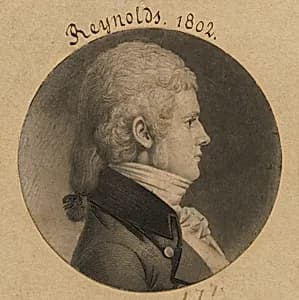
This elegant 1802 print portrays John Reynolds, captured in profile by French-born artist Charles Balthazar Julienévret de Saint-Mmin (1770–1852). Saint-Mémin, who fled the French Revolution and settled in America, revolutionized portraiture with his innovative "physiognotrace" device—a mechanical pantograph that traced precise silhouettes against a backlight. These outlines were then engraved on copper plates and hand-printed, often with subtle coloring, making high-quality likenesses affordable for the early American elite. Created during the early Federal period, when national identity was blossoming post-Revolution, this work exemplifies Saint-Mémin's signature style: stark, classical profiles evoking ancient Roman coins and medallions. His methodical technique produced over 900 portraits of prominent figures in Philadelphia, New York, and beyond, preserving the faces of America's founding generation. Housed in the Smithsonian American Art Museum's collection (gift of Mr. and Mrs. Paul Mellon to the National Portrait Gallery), this print offers a window into 19th-century portrait conventions and technological ingenuity, blending European precision with New World optimism. A testament to Saint-Mémin's enduring legacy, it invites us to ponder Reynolds's place in that vibrant era.