
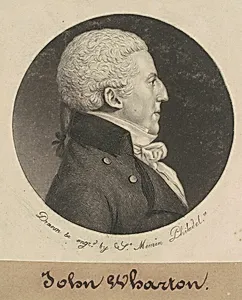
John Wharton
Medium
mezzotint and engraving in black on wove paper mounted to brown wove paper
Dimensions
image (irregular): 5.56 × 5.56 cm (2 3/16 × 2 3/16 in.) sheet (trimmed to plate): 6.67 × 6.19 cm (2 5/8 × 2 7/16 in.)
Classification
Department
CG-W
Museum
National Gallery of Art, Washington, D.C.
Credit
Corcoran Collection (Gift of William Wilson Corcoran)
Accession Number
2015.19.1584.11.6
Rights
Public Domain
Art Historical Context
Step into the refined world of early American portraiture with *John Wharton* (1799), a delicate print by Charles B. J. Févret de Saint-Mémin. This French-born artist, who arrived in Philadelphia after the Revolution, specialized in intimate profile likenesses of the new nation's elite. Using a physiognotrace—a mechanical tracing device—he captured precise silhouettes, which he then translated into engravings, making portraiture accessible beyond oil paintings for America's emerging middle and upper classes. Crafted in mezzotint and engraving on wove paper, the work measures a mere 2¼ inches square, its velvety blacks and crisp lines evoking the softness of a miniature painting. Mezzotint, prized for its tonal depth, allowed Saint-Mémin to achieve dramatic shading and lifelike texture on this small scale, mounted on brown wove paper for preservation and display. These prints were often collected in albums, serving as personal calling cards or family records. Housed in the National Gallery of Art's Corcoran Collection, *John Wharton* reflects the Federal era's fascination with identity and legacy, bridging European engraving traditions with American optimism. A testament to Saint-Mémin's innovative fusion of technology and artistry, it invites us to ponder the faces shaping a young republic.
About the Artist
Charles B. J. Févret de Saint-Mémin · 1770–1852
**Charles Balthazar Julien Févret de Saint-Mémin** Born on March 12, 1770, in Dijon, France, to marquis Bénigne-Charles Févret de Saint-Mémin, a former conseiller au Parlement de Bourgogne, and Victoire-Marie de Motmans, a creole from Port-au-Prince, Charles Balthazar Julien Févret de Saint-Mémin received a military education at the École Militaire in Paris, graduating in 1785. He served as a cad...