
Jonah
ca. 1885-1895
Medium
Painting
Classification
Painting
Department
Smithsonian Collection
Museum
Smithsonian American Art Museum
Credit
Smithsonian American Art Museum, Gift of John Gellatly
Accession Number
1929.6.98
Rights
Public Domain
Tags
About this artwork
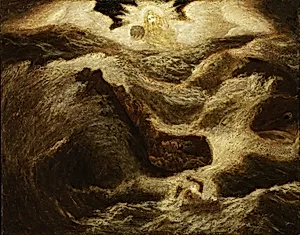
Jonah is one of Ryder's most densely painted canvases. He reworked this image so many times that the paint layers are still soft to the touch after more than a century. Ryder chose a Biblical tale of damnation, terror, and salvation that suited his poetic temperament and his manner of working. He was a thoughtful and literate painter who often found himself waiting for inspiration to strike. When the moment came, Ryder gave himself over to the act of painting, stopping only to gather his energy ...
Art Historical Context
Albert Pinkham Ryder's *Jonah* (ca. 1885–1895) captures the dramatic Biblical tale of the prophet swallowed by a whale, a story of damnation, terror, and divine salvation. Rendered in oil on canvas, this Smithsonian American Art Museum treasure depicts Jonah amid turbulent seas, a boat, and the looming whale, evoking the stormy chaos of the ocean's waves. Ryder, a reclusive 19th-century American artist by Romanticism and Symbolism, infused his works with mythic depth and poetic intensity, drawing from literature and scripture to explore human struggle against nature's fury. What sets *Jonah* apart is Ryder's obsessive technique: one of his most densely painted canvases, reworked countless times, leaving paint layers so thick they remain soft to the touch over a century later. He waited patiently for inspiration, then painted with fervent energy, his brush mirroring Jonah's desperate thrashing. This vigorous, textured impasto foreshadowed modernist experimentation. Ryder's mythic themes and bold handling inspired a generation of American artists, paving the way for the 20th-century avant-garde. Abstract Expressionist Jackson Pollock famously called him "the only American master who interests me," cementing Ryder's legacy as a bridge from Romanticism to abstraction. A gift from John Gellatly, *Jonah* invites visitors to ponder the artist's spiritual and emotional depths.
About the Artist
Albert Pinkham Ryder · 1847–1917
Largely self-taught, Albert Pinkham Ryder is widely considered one of America's greatest visionary painters. His intense use of color and mysterious themes are distinctly Romantic. Ryder moved with his family from New Bedford, Massachusetts to New York in 187, where he studied briefly at the New York National Academy of Design. He studied the engravings of Camille Corot and other Barbizon painters...