
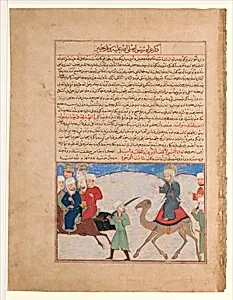
"Journey of the Prophet Muhammad", Folio from the Majma al-Tavarikh (Compendium of Histories)
ca. 1425
Medium
Ink, opaque watercolor, and gold on paper
Dimensions
H. 16 7/8 in. (42.8 cm) W. 13 in. (33 cm)
Classification
Codices
Department
Islamic Art
Museum
Metropolitan Museum of Art, New York, NY
Credit
Cora Timken Burnett Collection of Persian Miniatures and Other Persian Art Objects, Bequest of Cora Timken Burnett, 1956
Accession Number
57.51.9
Rights
Public Domain
Tags
Art Historical Context
This stunning folio from Hafiz-i Abru's *Majma al-Tavarikh* (Compendium of Histories), created around 1425, captures the "Journey of the Prophet Muhammad" in vivid Timurid miniature style. Commissioned during the reign of Shah Rukh, the Timurid ruler in Herat, the manuscript was a grand universal history blending text and illustration. As both author and artist, Hafiz-i Abru exemplified the era's scholarly artistry, where Persian painters revived classical traditions with intricate narratives of prophets, rulers, and legends. Here, figures of men and camels evoke a caravan procession, symbolizing sacred voyages central to Islamic lore. Crafted with ink outlines, opaque watercolors for jewel-like hues, and shimmering gold accents on paper, the work showcases Persian miniature techniques perfected in the 15th century. Opaque pigments ensured durable, vibrant colors that pop against the page, while gold added a divine glow, befitting depictions of holy figures. Measuring about 17 by 13 inches, this double-page spread invites viewers into a flattened, dreamlike space where perspective yields to rhythmic patterns and elegant silhouettes. Housed in the Metropolitan Museum of Art's Islamic Art collection, this folio from the Cora Timken Burnett bequest highlights Timurid patronage's cultural zenith. It bridges history and devotion, offering timeless insight into how medieval Persian artists visualized faith through beauty and precision.