
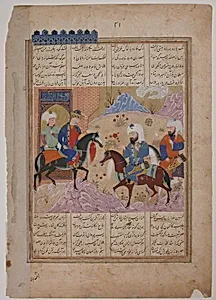
"Abu'l Mihjan and Sa`d ibn Abi Wakkas Become Angry and Leave King Khusrau (?)", Folio from a Khavarannama (The Book of the East) of ibn Husam al-Din
ca. 1476–86
Medium
Opaque watercolor on paper
Dimensions
H. 15 5/8 in. (39.7 cm) W. 10 7/8 in. (27.6 cm)
Classification
Codices
Department
Islamic Art
Museum
Metropolitan Museum of Art, New York, NY
Credit
Rogers Fund, 1955
Accession Number
55.125.3
Rights
Public Domain
Tags
Art Historical Context
This folio from the *Khavarannama* (The Book of the East), a 15th-century Persian epic poem by Ibn Husam al-Din, captures a dramatic moment of tension between legendary figures. Created around 1476–86 in opaque watercolor on paper, the illustration depicts Abu’l Mihjan and Sa’d ibn Abi Wakkas angrily departing from King Khusrau. The scene likely shows mounted warriors in flowing robes and armor, emphasizing emotional confrontation through expressive gestures and dynamic composition. As part of a larger illustrated manuscript, such folios brought epic tales of heroism, loyalty, and conflict to life for royal or elite audiences. Produced during the late Timurid period in Iran, this work reflects the refined tradition of Persian miniature painting, where artists used vibrant mineral pigments and fine brushwork to create intricate details on a small scale. The medium allowed for luminous colors and layered narratives within the confined space of a book page. These manuscripts served not only as literature but also as vehicles for cultural values, blending history, poetry, and moral lessons. Today, the folio offers modern viewers a window into medieval Islamic storytelling and artistic excellence, highlighting the enduring appeal of these epic narratives.