
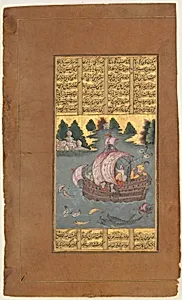
"Kai Khusrau Crosses the Sea", Folio from a Shahnama (Book of Kings) of Firdausi
ca. 1610
Medium
Ink, opaque watercolor, and gold on paper
Dimensions
Page: H. 8 in. (20.3 cm) W. 4 7/8 in. (12.4 cm) Painting: H. 5 3/8 in. (13.6 cm) W. 2 3/4 in. (7 cm)
Classification
Codices
Department
Islamic Art
Museum
Metropolitan Museum of Art, New York, NY
Credit
Gift of Wendy Findlay, 1982
Accession Number
1982.476.3
Rights
Public Domain
Tags
Art Historical Context
Behold the vibrant folio *"Kai Khusrau Crosses the Sea"* from a *Shahnama* (Book of Kings) by the legendary Persian poet Abu'l Qasim Firdausi. Created around 1610 during the Safavid era in Iran, this miniature captures a dramatic episode from the epic tale, where the heroic king Kai Khusrau navigates perilous waters. Men aboard ships brave the waves, with fish teeming below, evoking the mythical perils of the journey in Firdausi's 10th-century masterpiece—a chronicle of Iran's ancient kings and legends that shaped Persian identity. Rendered in ink, opaque watercolor, and gold on paper, the artwork exemplifies Persian miniature painting. The small painting (5 3/8 x 2 3/4 inches) bursts with jewel-like colors and intricate details, typical of Safavid codices. Gold accents illuminate the sea and vessels, creating a sense of otherworldly splendor, while the flattened perspective and dynamic figures blend narrative storytelling with decorative elegance. Housed in the Metropolitan Museum of Art's Islamic Art Department, this gift from Wendy Findlay in 1982 highlights the *Shahnama*'s enduring cultural role. These illuminated manuscripts were prized treasures, blending poetry, history, and artistry to inspire generations with tales of valor and divine fate.
About the Artist
Abu'l Qasim Firdausi · 935–1020
Abu'l Qasim Firdausi, born around 940 in the village of Paj near Tus in Khorasan (modern-day Iran), emerged from a family of landed gentry known as dehqans, who preserved ancient Iranian oral traditions amid the cultural renaissance of the Samanid Empire. Little is documented about his early life or formal training, though he likely received a basic education including Arabic literacy, immersing h...