
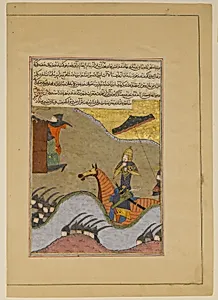
"Conquest of Baghdad by Timur", Folio from a Zafarnama (Book of Victory)
Dhu'l Hijja 839 A.H./June–July 1436 CE
Medium
Ink, opaque watercolor, and gold on paper
Dimensions
H. 11 3/8 in. (28.9 cm) W. 8 in. (20.3cm)
Classification
Codices
Department
Islamic Art
Museum
Metropolitan Museum of Art, New York, NY
Credit
Rogers Fund, 1955
Accession Number
55.121.17
Rights
Public Domain
Tags
Art Historical Context
This stunning folio from the *Zafarnama* (Book of Victory), titledConquest of Baghdad byur," captures a pivotal moment in the campaigns of the Turco-Mongol conquer Timur (Tamer). Created in June–July 1436 CE during the Timurid era, it illustrates the dramatic siege and fall of Baghdad in 140, a city long central to Islamic culture. The *Zafarnama*, by Sharaf al-D 'Ali Yazdi, chronicles Timur's triumphs, blending history with heroic narrative to glorify his legacy. Attributed to illuminator Ya'qub ibn Hasan, known as Siraj al-Husaini, this page hails from a luxurious codex in the Metropolitan Museum of Art's Islamic Art collection. Executed in ink, opaque watercolor, and gold on paper (measuring 11 3/8 x 8 inches), the artwork exemplifies Timurid miniature painting. Vibrant gouache colors and shimmering gold heighten the dynamism of charging horses and armored men, evoking the chaos of battle with intricate details in figures, architecture, and landscapes. These techniques, rooted in Persian manuscript traditions, served not just decoration but also to educate and inspire courtly audiences. As a codex folio, it reflects the cultural zenith of Timurid patronage for the arts, where history was visualized to affirm power. Visitors will appreciate how such works preserved epic tales, bridging history and artistry in the Islamic world. (218 words)