
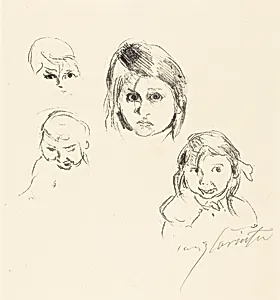
Kinderköpfe (Heads of Children)
1914
Medium
lithograph in black on laid paper
Dimensions
sheet: 48.2 x 38.4 cm (19 x 15 1/8 in.)
Classification
Department
CG-W
Museum
National Gallery of Art, Washington, D.C.
Credit
Gift of the Marcy Family in memory of Sigbert H. Marcy
Accession Number
1991.210.39
Rights
Public Domain
Art Historical Context
**Kinderköpfe (Heads Children)**, a poignant 1914 lithograph by Lovis Corinth, the delicate features of children's faces in stark black ink on laid paper. Measuring 48.2 x 38.4 cm, this print from the National Gallery of Art collection—generously gifted by the Marcy Family in memory of Sigbert H.cy—exemplifies Corinth's mastery of graphic arts during a turbulent time. Created on the eve of World War, it reflects the artist's late-career focus on intimate, expressive portraits amid personal and global upheaval. Corinth (1858–1925), a pivotal figure in German Expressionism and a founder of the Berlin Secession, evolved from Impressionist influences to bold, psychological depth, especially after a 1911 stroke that infused his work with vigorous energy. Here, lithography—a 19th-century technique using greasy crayon on stone for fluid, painterly effects—allowed him to achieve rich tonal contrasts and spontaneous lines, bridging his painting and printmaking worlds. This work highlights children's innocence through simplified forms and dramatic shading, inviting viewers to ponder themes of youth and fragility. As a classified print in the CG-W Department, it showcases how Corinth democratized his vision, making high art accessible via multiples while preserving emotional immediacy. A gem for print enthusiasts!
About the Artist
Lovis Corinth · 1858–1925
Lovis Corinth, born Franz Heinrich Louis on July 21, 1858, in Tapiau, East Prussia (now Gvardeysk, Russia), to a tanner father, displayed prodigious drawing talent from childhood. He began formal training at the Königsberg Academy in 1876, then moved to the Academy of Fine Arts in Munich from 1880 to 1884, studying under Ludwig von Löfftz and briefly Franz von Defregger, where he absorbed a Realis...