
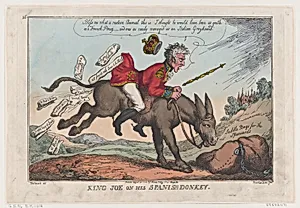
King Joe on his Spanish Donkey
Medium
Hand-colored etching
Dimensions
Sheet: 10 1/16 × 14 11/16 in. (25.5 × 37.3 cm) Plate: 9 5/8 × 13 9/16 in. (24.5 × 34.5 cm)
Classification
Prints
Department
Drawings and Prints
Museum
Metropolitan Museum of Art, New York, NY
Credit
The Elisha Whittelsey Collection, The Elisha Whittelsey Fund, 1959
Accession Number
59.533.1171
Rights
Public Domain
Tags
Art Historical Context
**King Joe on his Spanishkey** (1808) is a vibrant hand-colored etching British satirist Thomas Rowlandson, with contributions from George Murgatroyd Woodward and publisher Thomasegg. Measuring about 10 by 14 inches, this print from the Metropolitan Museum of Art Drawings and Prints collection captures the sharp wit of early 19th-century political caricature. The title mocks "King Joe"—Joseph Bonaparte, Napoleon's brother, hastily crowned King of Spain in June 8 amid French occupation—forcing him onto a lowly "Spanish donkey," a symbol of ridicule blending the animal with Spanish stereotypes and perhaps the era's torture devices. Created just months into the Peninsular War, when British forces resisted Napoleon's Iberian ambitions, the artwork exemplifies anti-French propaganda. Rowlandson's exaggerated figures and dynamic composition lampoon Joseph's unstable throne, reflecting widespread British glee at Spain's resistance and the Bonaparte regime's unpopularity. Hand-coloring adds lively hues, heightening the humor and making the satire pop for Georgian audiences who devoured such prints in taverns and shops. Rowlandson's loose, expressive etching style, rooted in the caricature tradition, underscores the print's cultural punch: a snapshot of wartime morale-boosting art that humanized (or dehumanized) emperors' kin through donkey-riding folly. A delightful glimpse into how satire shaped public opinion during turbulent times! (198 words)
About the Artist
Thomas Rowlandson|Thomas Tegg|George Murgatroyd Woodward|Joseph Bonaparte · 1756–1827
Thomas Rowlandson (1757–1827) was an English artist and caricaturist whose satirical watercolors and prints captured the social life of Georgian Britain with unparalleled wit and technical mastery. Alongside James Gillray, he is recognized as one of the greatest British graphic artists, and his distinctive flowing line and keen observations have made his work integral to understanding late 18th an...