
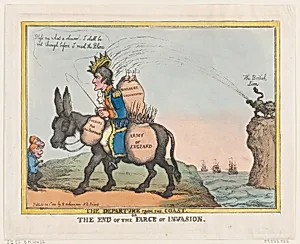
The Departure from the Coast, or the End of the Farce of Invasion
October 1, 1805
Medium
Hand-colored etching
Dimensions
Sheet: 11 15/16 × 14 11/16 in. (30.3 × 37.3 cm) Plate: 11 1/4 × 13 9/16 in. (28.5 × 34.5 cm)
Classification
Prints
Department
Drawings and Prints
Museum
Metropolitan Museum of Art, New York, NY
Credit
The Elisha Whittelsey Collection, The Elisha Whittelsey Fund, 1959
Accession Number
59.533.932
Rights
Public Domain
Tags
Art Historical Context
Created in 1805 by renowned British caricaturist Thomasson and published by Rudolph Ackermann in London, *The Departure the Coast, or the of the Farce of Invasion* is a hand-colored that captures the sharp wit of Georgian satire. Measuring about 12 by 15 inches, this print exemplifies the vibrant, affordable medium popular for political commentary, where delicate etching lines were enhanced by hand-applied watercolors to heighten visual punch and appeal to a wide audience. The artwork skewers Napoleon I and his abortive plans to invade Britain during the Napoleonic Wars. Timed just weeks before Admiral Nelson's triumph at Trafalgar on October 21, it mocks the French emperor's "Grande Armée" camped along the Channel coast as a ridiculous flop—a "farce" ending in hasty retreat. Donkeys in the scene likely symbolize the bumbling invaders, a common satirical trope equating foes with foolish beasts, reflecting British glee and propaganda against the existential invasion threat. Rowlandson's loose, exaggerated style, rooted in the caricature tradition, made him a master of humorous prints that both entertained and shaped public opinion. Housed in the Metropolitan Museum of Art's Drawings and Prints department, this piece highlights how art fueled national morale amid geopolitical tension, blending politics, humor, and cultural resilience.
About the Artist
Thomas Rowlandson|Rudolph Ackermann, London · 1756–1827
Thomas Rowlandson (1757–1827) was an English artist and caricaturist whose satirical watercolors and prints captured the social life of Georgian Britain with unparalleled wit and technical mastery. Alongside James Gillray, he is recognized as one of the greatest British graphic artists, and his distinctive flowing line and keen observations have made his work integral to understanding late 18th an...