
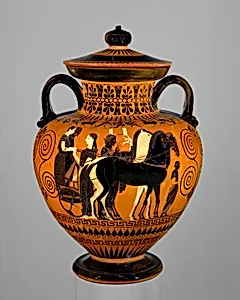
Knob from the lid of a neck-amphora, joins lid of 17.230.14
Unknown Artist
ca. 540 BCE
Medium
Terracotta
Dimensions
H. 2 1/8 in. (5.4 cm)
Classification
Vases
Culture & Period
Greek, Attic · Archaic
Department
Greek and Roman Art
Museum
Metropolitan Museum of Art, New York, NY
Credit
Gift of J. D. Beazley, 1927
Accession Number
27.16
Rights
Public Domain
Tags
Art Historical Context
This delicate terracotta knob, dating to around 540 BCE, once adorned the lid of an Attic neck-amph—a graceful two-handled jar used in ancient Greek households for storing wine or oil. Standing just over 2 inches tall, exemplifies Archaic Greek pottery from Athens, a period when black-figure technique dominated. Artisans painted figures in glossy black slip on a fired clay surface, then incised fine details to reveal the red clay beneath, creating vivid contrasts full of life and movement. The knob's miniature scene bursts with energy, featuring men, women, horses, and chariots—likely evoking a mythological procession or triumphant race, motifs popular in Attic vase-painting that celebrated heroism and daily spectacle. Such knobs were not mere functional toppers but miniature masterpieces, showcasing the potter's and painter's skill in capturing dynamic compositions on a tiny scale. Gifted to the Metropolitan Museum of Art in 1927 by renowned scholar J.D. Beazley, this fragment invites us to marvel at the ingenuity of anonymous Archaic artists. It reminds us how everyday objects in ancient Greece doubled as storytelling canvases, bridging the mortal world and epic tales.