
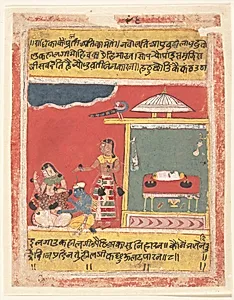
Krishna at the Feet of Radha: Page from a Dispersed Rasikapriya
Unknown Artist
1634
Medium
Ink and opaque watercolor on paper
Dimensions
Image: 7 1/4 × 5 1/2 in. (18.4 × 14 cm) Mat: 7 7/8 × 6 1/4 in. (20 × 15.9 cm) Sheet: 8 3/8 × 6 5/8 in. (21.3 × 16.8 cm)
Classification
Paintings
Culture
India (Madhya Pradesh, Malwa)
Department
Asian Art
Museum
Metropolitan Museum of Art, New York, NY
Credit
Rogers Fund, 1951
Accession Number
51.58
Rights
Public Domain
Tags
Art Historical Context
This exquisite page from a dispersed *Rasikapriya* manuscript, created in 1634 in the Malwa region of India (present-day Madhya Pradesh), captures a tender moment from the legendary love story of Krishna and Radha.itled *Krishna at the Feet Radha*, it illustrates the divine devotee Krishna humbly bowing before his beloved Radha, embodying the poetic themes of the 16th-century text by Keshavdas. The *Rasikapriya* ("Connoisseur of Emotions") explores the subtle moods (*rasas*) of romantic love through Krishna's exploits, a popular subject in Indian miniature painting traditions. Rendered in ink and opaque watercolor on paper—a hallmark of Mughal-influenced regional schools—the artwork showcases the Malwa style's vibrant jewel tones, intricate borders, and delicate figures with expressive almond-shaped eyes. Peacocks, symbols of Krishna's divine allure, likely grace the scene, adding a lush, naturalistic backdrop typical of these intimate 7¼ × 5½-inch folios. The opaque pigments create a glowing, jewel-like quality, enhancing the emotional depth. Rooted in the Bhakti devotional movement, this painting celebrates Krishna and Radha as archetypes of sacred love and longing, offering spiritual insight to 17th-century viewers. Acquired through the Rogers Fund in 1951, it now resides in the Metropolitan Museum of Art's Asian Art collection, exemplifying Malwa's poetic fusion of art, literature, and mysticism.