
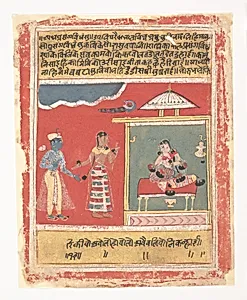
Radha's Friend Pleads with Her to Receive Krishna: Page from a Dispersed Rasikapriya
Unknown Artist
1634
Medium
Ink and opaque watercolor on paper
Dimensions
7 3/4 x 6 in. (19.7 x 15.2 cm)
Classification
Paintings
Culture
India (Madhya Pradesh, Malwa)
Department
Asian Art
Museum
Metropolitan Museum of Art, New York, NY
Credit
Rogers Fund, 1935
Accession Number
35.34
Rights
Public Domain
Tags
Art Historical Context
This exquisite page from a dispersed *Rasikapriya* manuscript, created in 1634 in the Malwa region of India (modern Madhya Pradesh), captures a tender moment from Hindu mythology: Radha's friend pleading with her to accept the advances of Krishna, the divine lover. The *Rasikapriya*, a 16th-century poetic treatise by Keshavdas, explores the nuanced emotions of romantic love through Radha and Krishna's iconic story, blending devotion (*bhakti*) with earthly passion. Such illustrated folios were prized by Mughal-era courts and nobility, reflecting the vibrant regional painting traditions that flourished alongside imperial ateliers. Rendered in ink and opaque watercolor on paper—a hallmark of Indian miniature painting—the artwork's intimate scale (just 7 3/4 x 6 inches) invites close viewing. Malwa artists favored bold, jewel-like colors, intricate borders, and symbolic motifs like peacocks, sacred to Krishna as symbols of beauty and romance. Women dominate the composition, their expressive gestures and flowing garments conveying emotional drama against stylized landscapes. Housed in the Metropolitan Museum of Art's Asian Art collection (Rogers Fund, 1935), this anonymous masterpiece exemplifies Malwa's golden age, bridging devotional poetry and visual storytelling. It reminds us how art immortalized eternal tales of love, inspiring generations in India's rich cultural tapestry.