
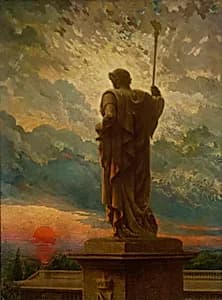
L' Empereur
1912
Medium
Painting
Classification
Painting
Department
Smithsonian Collection
Museum
Smithsonian American Art Museum
Credit
Smithsonian American Art Museum, Gift of Mrs. James Carroll Beckwith
Accession Number
1924.3.1
Rights
Public Domain
Tags
Art Historical Context
Carroll Beckwith's *L'Empereur* (The Emperor), painted in 1912, captures a poignant historical vision centered on Napoleon Bonaparte, evoking themes of war, ambition, and reflection. This oil painting, now housed in the Smithsonian American Art Museum as a gift from the artist's widow, Mrs. James Carroll Beckwith, showcases Beckwith's academic training in Paris under masters like Carolus-Duran. His style blends realistic portraiture with dramatic lighting, influenced by 19th-century French traditions, making him a bridge between European classicism and American art. The work's sunset backdrop and tags like "vision" suggest a meditative moment for the iconic emperor, perhaps contemplating his conquests amid fading light—a metaphor for glory's transience. Created just before World War I, it reflects early 20th-century fascination with Napoleon's legacy as both military genius and cautionary tale of hubris. Beckwith, an expatriate artist who exhibited at the Paris Salon, infused his paintings with historical gravitas, inviting viewers to ponder power's ephemerality. A gem of the Smithsonian's collection, *L'Empereur* reminds us how art immortalizes fleeting human triumphs.
About the Artist
Carroll Beckwith (American) · 1852 –1917
American, Hannibal, Missouri 1852–1917 New York