
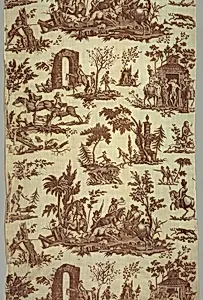
"La course au Sanglier" "The Boar Hunt"
Classification
printed, dyed & painted textiles
Department
Smithsonian Collection
Museum
Smithsonian American Art Museum
Credit
Smithsonian American Art Museum
Accession Number
1939-38-2-a
Rights
Public Domain
About this artwork
Research in Progress
Art Historical Context
Claude-Louis Desrais’s “La course au Sanglier” (“The Boar Hunt”), created around 1785, captures the excitement of a traditional French hunting scene on a printed, dyed, and painted textile. As a French artist active in late eighteenth century, Desrais specialized in lively drawings and designs that were often adapted for decorative arts. The work’s classification as a textile suggests it was intended not only as an image but as a functional piece of fabric—perhaps for furnishing or clothing—bringing dramatic outdoor action into domestic spaces. Hunting scenes like this one were popular among the French nobility, symbolizing bravery, status, and a connection to the land just before the upheavals of the Revolution. The dynamic composition likely shows riders and hounds in pursuit, rendered through the intricate techniques of textile printing and painting that flourished in France during this period. These methods allowed vivid colors and narrative detail to be reproduced on cloth, making aristocratic pastimes accessible in new, everyday forms. Today, the piece resides in the Smithsonian American Art Museum, where it offers visitors a glimpse into how art, fashion, and social ritual intertwined in the final decades of the ancien régime. Though research on the exact production remains ongoing, the textile stands as a lively testament to eighteenth-century storytelling through both image and material.