
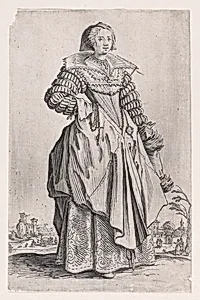
La Dame a la Grande Collerette et a la Coiffe Retombant en Arrière (The Lady with the Large Collar and a Headdress that Falls to the Back), from La Noblesse (The Nobility)
ca. 1623
Medium
Etching
Dimensions
Sheet: 5 9/16 x 3 5/8 in. (14.1 x 9.2 cm)
Classification
Prints
Department
Drawings and Prints
Museum
Metropolitan Museum of Art, New York, NY
Credit
Bequest of Edwin De T. Bechtel, 1957
Accession Number
57.650.347(9)
Rights
Public Domain
Tags
Art Historical Context
Step into the elegant world of 17th-century French nobility with Jacques Callot's etching *La Dame a la Grande Collerette et a laiffe Retombant enrière* (The Lady with the Large Collar a Headdress that Falls the Back), created around 1623. Part of Callot's series *Lalesse* (The Nobility), intimate print (just 5 9/16 x 3 5/8 inches) captures the opulent fashion of the Lorraine court, where Callot served as a renowned printmaker. A master of the Baroque era, he blended meticulous detail with dynamic composition, elevating etching from mere reproduction to high art. The subject, a poised noblewoman, showcases the era's extravagant attire: a massive starched ruff collar framing her face like a theatrical halo, paired with a flowing headdress that cascades backward in soft folds. Callot's etching technique—using fine, needle-like lines on a copper plate—allowed for unprecedented intricacy, rendering lace, fabrics, and expressions with jewel-like precision. This small-scale marvel reflects the cultural obsession with status symbols amid the Thirty Years' War's shadows, immortalizing aristocratic grace. Housed in the Metropolitan Museum of Art's Drawings and Prints department (Bequest of Edwin De T. Bechtel, 1957), this work highlights Callot's influence on printmaking, inspiring later artists like Rembrandt. It's a window into a vanishing world of splendor, inviting us to admire the artistry in everyday elegance.
About the Artist
Jacques Callot · 1592–1635
Jacques Callot (1592–1635) was a French printmaker and draftsman from the Duchy of Lorraine, widely regarded as one of the first great artists to practice the graphic arts exclusively. His more than 1,400 etchings chronicled the breadth of 17th-century life, from Medici court festivities to the brutal realities of warfare. Callot revolutionized etching through technical innovations including the é...