
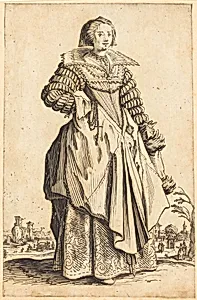
Noble Woman with Large Collar
c. 1620/1623
Medium
etching on laid paper
Dimensions
sheet (trimmed within plate mark): 15 × 10 cm (5 7/8 × 3 15/16 in.)
Classification
Department
CG-E
Museum
National Gallery of Art, Washington, D.C.
Credit
Rosenwald Collection
Accession Number
1949.5.410
Rights
Public Domain
Art Historical Context
Behold the elegant *Noble Woman with Large*, an exquisite etching by the masterful French printmaker Jacques Callot, created around 1620-1623. Measuring just 15 × 10 cm on laid paper, intimate work captures the poise of 17th-century nobility, with its subject's elaborate ruff collar—a hallmark of Baroque fashion symbolizing wealth and status. Callot, a pioneer of etching techniques, rendered her intricate lace and attire with astonishing precision, using his innovative "échelle" method of multiple overlapping bites to achieve unprecedented fine lines and textures. During the early Baroque era, Callot worked for the Medici court in Florence, producing series of prints that documented costumes, festivals, and daily life across Europe. This piece likely belongs to such a fashion study, offering a window into the opulent dress of the nobility amid the Thirty Years' War's upheavals. Etching on laid paper, with its subtle chain lines, was ideal for Callot's meticulous detail, making prints like this both affordable art objects and portable treasures for collectors. Housed in the National Gallery of Art's Rosenwald Collection, this trimmed sheet exemplifies Callot's enduring influence on printmaking, bridging painting and graphic arts. Visitors will appreciate its delicate beauty, a testament to how a tiny etching can evoke the grandeur of a vanished courtly world.
About the Artist
Jacques Callot · 1592–1635
Jacques Callot (1592–1635) was a French printmaker and draftsman from the Duchy of Lorraine, widely regarded as one of the first great artists to practice the graphic arts exclusively. His more than 1,400 etchings chronicled the breadth of 17th-century life, from Medici court festivities to the brutal realities of warfare. Callot revolutionized etching through technical innovations including the é...