
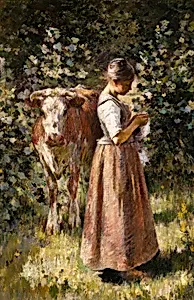
La Vachère
ca. 1888
Medium
Painting
Classification
Painting
Department
Smithsonian Collection
Museum
Smithsonian American Art Museum
Credit
Smithsonian American Art Museum, Gift of William T. Evans
Accession Number
1909.7.58
Rights
Public Domain
Tags
Art Historical Context
Theodore Robinson’s “La Vachère,” painted around 1888, offers a quiet glimpse into rural French life during the height of theist era. An American artist who spent significant time in Giverny, Robinson was deeply influenced by Claude Monet and became one of the first U.S. painters to fully adopt Impressionist techniques. The title, French for “The Cowherd,” points to a scene of a young woman tending dairy cattle, rendered at full length against a sunlit landscape. Robinson’s loose brushwork and sensitive handling of light capture the fleeting effects of daylight on figures and animals, transforming an ordinary pastoral moment into something luminous and immediate. Rather than idealizing rural labor, he presents it with natural dignity, aligning with the Impressionist interest in everyday subjects. Housed in the Smithsonian American Art Museum through the generosity of William T. Evans, the painting reflects the vibrant artistic exchange between American and European painters at the turn of the century. It stands as a fine example of Robinson’s ability to blend French innovations with his own clear-eyed observation of the natural world.