
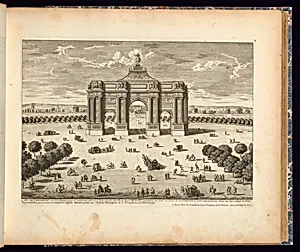
L’ARC DE TRIOMPHE
late 17th century
Classification
Department
Smithsonian Collection
Museum
Smithsonian American Art Museum
Credit
Purchased for the Museum by the Advisory Council
Accession Number
1921-6-533-66
Rights
Public Domain
About this artwork
Research in Progress
Art Historical Context
Step into the grandeur of 17th-century France withL’Arc de Triomphe*, a captivating print by Adam Perelle (1638–1695), a master French engraver renowned for his depictions of the era’s architectural marvels. Created in the late 1600s during the opulent reign of Louis XIV this work likely captures one of Paris’s triumphal arches—symbols of royal power and military victory, such as the Porte Saint-Martin similar monuments erected to celebrate the Sun King’s triumphs. Perelle’s prints, often produced in series, brought the splendor of French landmarks to a wider audience, blending artistry with topography. As a print, the medium itself highlights the revolutionary role of engraving in disseminating images during the Baroque age. Perelle’s technique—precise lines and intricate details—allowed for affordable reproductions that educated and inspired viewers across Europe, from nobility to scholars. Though the exact medium remains under research, such works were typically etchings or engravings on paper, preserving the monumental scale in miniature form. Housed in the Smithsonian American Art Museum’s collection, purchased by the Advisory Council, this piece offers a window into absolutist France’s cultural pride. Imagine the bustling streets of Paris alive with pageantry—*L’Arc de Triomphe* invites us to marvel at how art immortalized a king’s legacy. (198 words)