
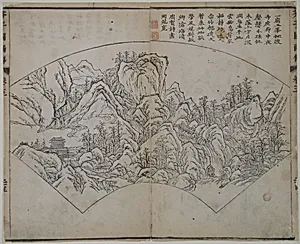
清 王槩 設計,李漁出版 芥子園畫傳 版本|Landscape after Fan Kuan (active ca. 990–1030), from the Mustard Seed Garden Manual of Painting
First edition, 1679
Medium
Woodblock print; ink and color on paper
Dimensions
9 5/8 x 11 13/16 in. (24.4 x 30 cm)
Classification
Prints
Culture & Period
China · Qing dynasty (1644–1911)
Department
Asian Art
Museum
Metropolitan Museum of Art, New York, NY
Credit
Rogers Fund, 1924
Accession Number
CP29
Rights
Public Domain
Tags
Art Historical Context
This exquisite woodblock print from the edition of the *Mustard Seed Garden Manual of* (1679), by Wang Gai and published Li Yu, captures a landscape inspired by the Northern Song master Fan Kuan (active ca 990–1030). Rendered in ink and color on paper, it depicts towering mountains, lush trees, and humble houses nestled in nature, evoking the sublime power of the Chinese *shan shui* (ains and water) tradition. Measuring just 9⅝ × 11⅞ inches, its intimate scale belies the grandeur of the original style. Fan Kuan, a pioneer of monumental landscape painting, emphasized realism and spiritual harmony with nature, often painting from life amid mist-shrouded peaks. This print faithfully reproduces his approach, serving as a model for aspiring artists in the Qing dynasty (1644–1911). The manual revolutionized art education by providing precise outlines, color guides, and brushstroke instructions via affordable woodblock printing—a technique that allowed widespread dissemination of classical compositions. As a cornerstone of Chinese artistic pedagogy, the *Mustard Seed Garden* influenced generations, bridging Song-era monumentalism with Qing literati culture. Housed in the Metropolitan Museum of Art's Asian Art department (Rogers Fund, 1924), it invites visitors to appreciate how printmaking democratized elite painting traditions, blending technical mastery with timeless reverence for the natural world.
About the Artist
Wang Gai|Fan Kuan · 1645–1710
Wang Gai (王概, 1645–1710), a prominent Qing dynasty painter from Xiushui in Zhejiang province, established himself in the vibrant cultural hub of Nanjing, where he flourished from around 1677 to 1705. Born into a scholarly family—his father-in-law was the renowned writer Li Yu (1611–1680)—Gai trained under the master Gong Xian (1619–1689), one of the Eight Masters of Jinling, adopting his robust la...