
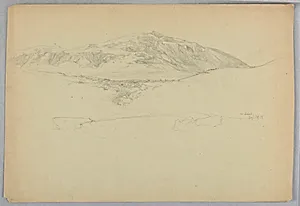
Landscape Sketch, Mount Desert, Maine
August 19, 1856
Medium
landscapes
Classification
landscapes
Department
Smithsonian Collection
Museum
Smithsonian American Art Museum
Credit
Bequest of Erskine Hewitt
Accession Number
1942-50-144
Rights
Public Domain
About this artwork
Research in Progress
Art Historical Context
Daniel Huntington's *Landscape Sketch, Mount Desert, Maine*, dated August 19, 1856, captures the rugged beauty of one of America's most dramatic coastal landscapes. Painted on location during a summer sketching trip, this work reflects the 19th-century American artist's deep appreciation for the nation's wild frontiers. Huntington (1816–1906), a prominent figure in the Hudson River School tradition, often blended meticulous realism with a sense of sublime nature, emphasizing light, atmosphere, and expansive vistas in his landscapes. Mount Desert Island, off the coast of Maine, was a magnet for artists in the mid-1800s, its granite peaks and Atlantic shores inspiring the Luminist style's focus on tranquil, glowing scenes. As a quick sketch—likely executed in oil or pencil—this piece served as a vital study for larger studio paintings, showcasing Huntington's on-site observation techniques. It highlights the era's growing cultural reverence for preserving America's untouched wilderness, just decades before Mount Desert became the heart of Acadia National Park. Today, housed in the Smithsonian American Art Museum through the bequest of Erskine Hewitt, this modest yet evocative work invites us to ponder the fleeting moments that fueled grand artistic visions. A window into Huntington's process, it reminds visitors of the intimate connection between artist and land.