
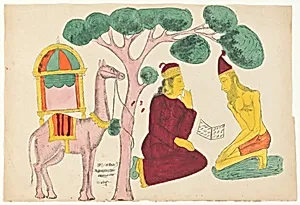
Layla Visiting Majnun in the Desert
August 26, 1856
Medium
Lithograph and applied watercolor and selectively applied glaze
Dimensions
Image: 11 3/16 × 16 3/8 in. (28.4 × 41.6 cm)
Classification
Prints
Culture
West Bengal, Kalighat, Calcutta
Department
Asian Art
Museum
Metropolitan Museum of Art, New York, NY
Credit
Purchase, David E. Stutzman and John D. Lamb Gift, 2020
Accession Number
2021.145
Rights
Public Domain
Tags
Art Historical Context
In the vibrant tradition of 19th-century Kalighat painting from Calcutta (now Kolkata), West Bengal, *Layla Visiting Majnun in the Desert* (1856) by Becharam Das Dutta captures a poignant moment from one of South Asia's most enduring love stories. This lithograph, enhanced with applied watercolor and selective glaze, depicts the devoted Layla approaching her beloved Majnun amid a stark desert landscape dotted with camels, trees, men, and women. Measuring 11 3/16 × 16 3/8 inches, it exemplifies the bold, expressive style of Kalighat artists—patuas who transitioned from hand-painted scrolls to affordable printed images sold to pilgrims and the urban middle class near the Kali Temple. Kalighat prints like this one emerged in the 1830s–60s, blending folk art with emerging lithography technology introduced by British colonial presses. Dutta's work reflects the school's signature flat colors, sharp outlines, and satirical or narrative flair, often drawing from Persian and Bengali literature. The Layla-Majnun tale, popularized through poetry by Amir Khusrau and others, symbolizes divine, unattainable love, resonating deeply in Bengali Muslim and Hindu cultures alike. The applied watercolor and glaze lend a luminous, jewel-like quality, making this everyday devotional art feel almost sculptural. Acquired by the Metropolitan Museum of Art in 2020 through the David E. Stutzman and John D. Lamb Gift, it offers visitors a window into colonial India's dynamic print culture, where myth met modernity.