
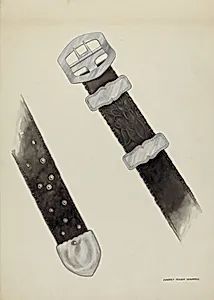
Leather Belt
c. 1936
Medium
watercolor, graphite, and pen and ink on paper
Dimensions
overall: 35.5 x 24.8 cm (14 x 9 3/4 in.)
Classification
Index of American Design
Department
CG-W
Museum
National Gallery of Art, Washington, D.C.
Credit
Index of American Design
Accession Number
1943.8.14249
Rights
Public Domain
Art Historical Context
Step into the rich tradition of American craftsmanship with *Leather Belt*, a meticulous rendering by Harry Mann Wadd from around 1936. This artwork is part of the Index of American Design, a Federal Art Project under the Works Progress Administration (WPA) during the Great Depression. Launched in 1935, the Index employed artists across the U.S. to create thousands of detailed drawings documenting folk, decorative, and popular arts—preserving cultural heritage at a time when economic hardship threatened traditional skills. Waddell masterfully captures the belt's intricate tooled leather patterns using watercolor for vibrant color, graphite for subtle shading, and pen and ink for precise lines. At 35.5 x 24.8 cm, the sheet allows for an intimate study of textures and motifs, likely inspired by Southwestern or folk leatherworking traditions. This multi-medium approach exemplifies the Index's goal: not mere copies, but interpretive illustrations that highlight design excellence and historical value. Housed in the National Gallery of Art's Index of American Design collection, *Leather Belt* celebrates everyday artistry, reminding us how ordinary objects embody cultural identity. It's a testament to the WPA's role in fostering national pride through art, inviting visitors to appreciate the beauty in functional design.
About the Artist
Harry Mann Waddell · 1855–present
Harry Mann Waddell (1876–1956) was an American artist born on June 22, 1876, in Ohio, whose career flourished in California after he settled in Los Angeles by 1936. There he established a studio, working as a freelance draftsman while creating fine art in his spare time. His early life and formal training remain not well documented, but by the late 1930s, Waddell had become a key contributor to th...