
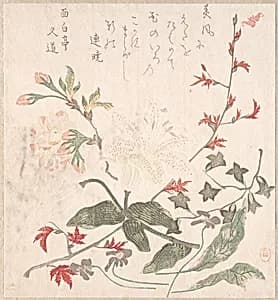
Lily, Violets, Cherry Blossoms, Forsythia, and a Branch of Red Maple
18th–19th century
Medium
Woodblock print (surimono); ink and color on paper
Dimensions
7 11/16 x 7 1/16 in. (19.5 x 17.9 cm)
Classification
Prints
Culture & Period
Japan · Edo period (1615–1868)
Department
Asian Art
Museum
Metropolitan Museum of Art, New York, NY
Credit
H. O. Havemeyer Collection, Bequest of Mrs. H. O. Havemeyer, 1929
Accession Number
JP2209
Rights
Public Domain
Tags
Art Historical Context
This exquisite woodblock print, titled *Lily, Violets, Cherry Blossoms,ia, and a Branch Red Maple*, captures the delicate beauty of seasonal flowers in a compact, intimate format. Created by unidentified Japanese artist during the 18th–19th century Edo period (1615–1868), it just 7 11/16 x 7 1/16 inches, perfect for personal appreciation or gifting. The vibrant inks and colors on paper highlight blooming lilies, violets, cherry blossoms, forsythia, and fiery red maple leaves, blending spring's renewal with autumn's fleeting splendor. As a *surimono*—a luxurious, privately commissioned woodblock print—this artwork exemplifies Edo-era artistry, often produced for New Year's greetings, poetry gatherings, or celebrations. Unlike mass-produced ukiyo-e, surimono featured superior craftsmanship, with fine lines, subtle gradations (*bokashi*), and sometimes metallic pigments or embossing for a tactile richness. These prints were status symbols among literati, merging visual poetry with nature's ephemerality. In Japanese culture, such floral motifs symbolize life's transience (*mono no aware*), with cherry blossoms evoking impermanence and maples signaling autumn's passion. Part of the Metropolitan Museum of Art's H. O. Havemeyer Collection (bequest 1929), this piece invites visitors to savor the refined elegance of Edo printmaking, where everyday beauty becomes profound art.