
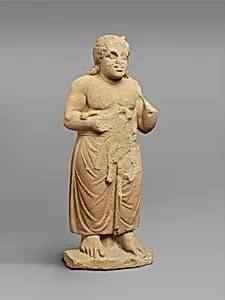
Limestone statue of a god
Unknown Artist
3rd century BCE
Medium
Limestone
Dimensions
WebPub GR 2012 Cesnola: 23 1/2 × 9 1/8 × 5 1/4 in., 35 lb. (59.7 × 23.2 × 13.3 cm, 15.9 kg)
Classification
Stone Sculpture
Culture & Period
Cypriot · Hellenistic
Department
Greek and Roman Art
Museum
Metropolitan Museum of Art, New York, NY
Credit
The Cesnola Collection, Purchased by subscription, 1874–76
Accession Number
74.51.2747
Rights
Public Domain
Tags
Art Historical Context
This striking limestone statue of a god crafted by an unknown Cypriot artist in the 3rd century BCE, embodies Hellenistic spirit on the island of Cyprus. Standing about 23½ inches tall and weighing 35 pounds, captures a divine male figure—likely a deity revered in local cults—during a period when Greek cultural influences merged with indigenous traditions following Alexander the Great's conquest. Cyprus, a strategic Mediterranean crossroads, produced such sculptures in limestone quarried locally, prized for its carvability and durability. Artistically, the statue showcases Hellenistic techniques: a naturalistic pose, detailed anatomy, and expressive features that blend idealized Greek forms with Cypriot vigor. Limestone allowed sculptors to achieve smooth surfaces and fine drapery folds, evident in the god's robust build. Its classification as stone sculpture highlights Cyprus's mastery in this medium, producing votive offerings for temples and sanctuaries. Acquired through the Cesnola Collection at the Metropolitan Museum of Art in the 1870s, this piece offers a window into Cypriot religious life, where gods symbolized protection and prosperity. Visitors can marvel at how such artifacts bridged worlds, preserving ancient devotion in enduring stone.