
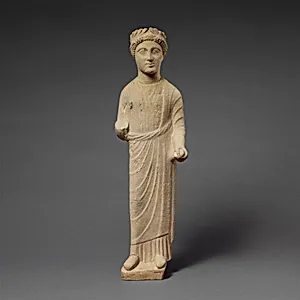
Limestone statuette of a beardless male votary with a wreath of leaves
Unknown Artist
2nd half of the 5th or early 4th century BCE
Medium
Limestone
Dimensions
H. 24 x 6 3/4 x 4 3/8 in. (61 x 17.1 cm, 4 3/8 in.)
Classification
Stone Sculpture
Culture & Period
Cypriot · Late Classical–Early Hellenistic
Department
Greek and Roman Art
Museum
Metropolitan Museum of Art, New York, NY
Credit
The Cesnola Collection, Purchased by subscription, 1874–76
Accession Number
74.51.2711
Rights
Public Domain
Tags
Art Historical Context
This limestone statuette depicts a beardless male vot, or religious devotee, adorned with a wreath of leavesning his head—a symbol of ritual offering or celebration in ancient rites. Standing about two feet tall, the figure embodies the solemn grace of Cypriot sculpture from the late 5th or early 4th century, during the Late Classical to Early Hellenistic period. Carved from local limestone, a durable medium abundant on Cyprus, it reflects the island's vibrant tradition of producing small-scale votive figures for sanctuaries, blending Greek influences with distinctive Eastern Mediterranean styles. Cypriot art like this flourished under a mix of Greek, Phoenician, and Egyptian inspirations, as Cyprus served as a cultural crossroads in the ancient world. The beardless youth, likely representing a worshipper dedicated to a deity such as Apollo (associated with laurel wreaths) or a fertility god, was probably placed in a temple to invoke divine favor. The sculptor's techniques—incised details for the wreath and simple, frontal pose—prioritize symbolic presence over realism, emphasizing piety over portraiture. Acquired through the Cesnola Collection in the 1870s, this piece at the Metropolitan Museum of Art offers a window into everyday devotion in ancient Cyprus, reminding us how ordinary people connected with the divine through such humble yet poignant gifts.