
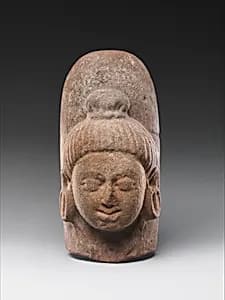
Linga with Face of Shiva (Ekamukhalinga)
Unknown Artist
first half of the 5th century
Medium
Sandstone
Dimensions
H. 6 7/8 in. (17.5 cm)
Classification
Sculpture
Culture & Period
India (Madhya Pradesh) · Gupta period
Department
Asian Art
Museum
Metropolitan Museum of Art, New York, NY
Credit
Samuel Eilenberg Collection, Gift of Samuel Eilenberg, 1987
Accession Number
1987.142.323
Rights
Public Domain
Tags
Art Historical Context
This exquisite sandstone sculpture, titled *Linga with Face of ShivaEkamukhalinga)*, hails from India's Madhya Pradesh region during the Gupta period's first half of the th century—a golden age of classical Indian art renowned for its refined elegance and spiritual depth. Carved from durable sandstone, the compact piece stands just 6 7/8 inches (17.5 cm) tall, suggesting it was likely used for personal devotion rather than temple rituals. The linga, an abstract cylindrical form symbolizing Shiva's creative energy in Hinduism, is uniquely adorned with a single serene face (ekamukha), embodying the god's divine presence. Gupta-era sculptors mastered stone carving techniques, achieving smooth, polished surfaces and harmonious proportions that convey ethereal grace. This work exemplifies the period's artistic pinnacle, where Hindu iconography blended abstraction with subtle anthropomorphism, reflecting a flourishing of Shaivism—the worship of Shiva. Produced amid the Gupta Empire's cultural renaissance, it captures the era's philosophical sophistication, where art served as a bridge between the material and divine. Today, this treasure from the Samuel Eilenberg Collection graces the Metropolitan Museum of Art's Asian Art department, inviting visitors to ponder Shiva's eternal mysteries through masterful ancient craftsmanship.