
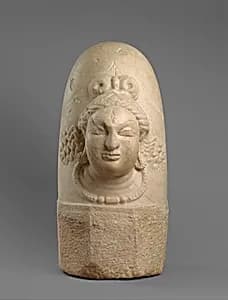
Linga with Face of Shiva (Ekamukhalinga)
Unknown Artist
9th century
Medium
White marble
Dimensions
H. 22 7/16 in. (57 cm); W. 13 3/16 in. (33.5 cm)
Classification
Sculpture
Culture & Period
Afghanistan · Shahi period
Department
Asian Art
Museum
Metropolitan Museum of Art, New York, NY
Credit
Rogers Fund, 1980
Accession Number
1980.415
Rights
Public Domain
Tags
Art Historical Context
Welcome to the Asian Art galleries, where we encounter the *Linga with Face of Shiva (Ekamukhalinga)*, a striking 9th-century white marble sculpture from Afghanistan's Shahi period. Standing 22 inches tall and 13 inches wide, this piece depicts the sacred linga—an abstract, columnar symbol of the Hindu god Shiva—adorned with a single face, known as *ekamukha* ("one-faced"). Crafted by an unknown artist, its smooth, luminous marble surface captures Shiva's serene yet powerful visage, blending divine abstraction with human-like features. The Shahi period (roughly 7th–10th centuries) marked a vibrant era in eastern Afghanistan and northwestern India, under Hindu dynasties that fostered temple art amid cultural exchanges with Central Asia. This linga reflects Shaivism's prominence, where the linga embodies Shiva's creative and destructive energies, often worshipped in rituals for fertility and spiritual renewal. White marble, prized for its purity and carvability, was a choice medium for such devotional icons, allowing intricate detailing on the face while preserving the linga's symbolic simplicity. Artistically, the sculpture's vertical form and frontal face invite contemplation, embodying Hindu concepts of transcendence. Unearthed from this remote Hindu stronghold, it offers a window into pre-Islamic religious life in the region, highlighting how portable stone carvings bridged sacred spaces and personal devotion. A testament to enduring faith, it reminds us of art's role in connecting the earthly and divine.