
Log Cabin Anecdotes
Medium
Classification
Department
Smithsonian Collection
Museum
Smithsonian American Art Museum
Credit
National Portrait Gallery, Smithsonian Institution
Accession Number
NPG.82.12
Rights
Public Domain
Tags
Art Historical Context
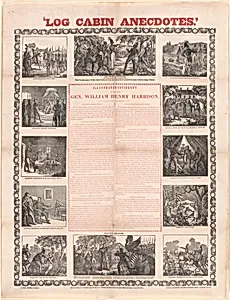
"Log Cabin Anecdotes" is a vibrant broadside print from 1840, created by an unidentified artist during the heated presidential campaign between William Henry Harrison and incumbent Martin Van Buren. as part of the Whig Party's innovative "Log Cabin and Hard Cider strategy, this print celebrates Harrison's frontier image as a war hero, general, and man of the people—complete with log cabins, horses, guns, swords, and even a Congressional Gold Medal. The Smithsonian American Art Museum holds this piece from the National Portrait Gallery's, highlighting its role in American political ephemera. Visually, the print blends exterior scenes of rustic log cabins and battlegrounds with interior details like chairs, tables, tents, trees, and Harrison's portrait, evoking simplicity and heroism tied to his Ohio and Indiana roots. As a medium, broadsides were affordable, large-sheet prints distributed widely to rally voters, making art accessible for mass persuasion rather than fine artistry. This technique democratized imagery, turning political messaging into a cultural phenomenon. Its significance lies in transforming Harrison's biography into folklore, cementing the log cabin as a symbol of American resilience. Though Harrison's presidency was tragically short, this print captures a pivotal moment when campaigns embraced populist visuals, influencing U.S. electoral culture ever after.