
Long-Tailed Cormorant, Plate 31 from Birds of Western Africa
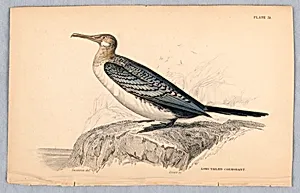
Medium
Classification
Department
Smithsonian Collection
Museum
Smithsonian American Art Museum
Credit
Gift of Hamill and Barker
Accession Number
1961-105-189
Rights
Public Domain
About this artwork
Research in Progress
Art Historical Context
This striking print, titled *Long-Tailed Cormorant*, was created in 1837 by Scottish artist and engraver William Home Lizars as Plate 31 in the publication *Birds of Western Africa*. Lizars, active during the height of 19th-century natural history illustration, specialized in detailed engravings that brought scientific accuracy to a broader audience. His work helped document avian species from regions then being explored by European naturalists, capturing the long-tailed cormorant’s distinctive silhouette and aquatic habits with meticulous care. As a hand-colored print, the medium allowed for widespread distribution of these images in books and portfolios, making exotic wildlife accessible to scholars and enthusiasts alike. Produced at a time when ornithology was rapidly advancing through global expeditions, Lizars’s contribution supported both scientific study and public appreciation of biodiversity in Western Africa. Today, this work resides in the Smithsonian American Art Museum collection, gifted by Hamill and Barker, preserving a vivid record of 19th-century efforts to catalog the natural world.