
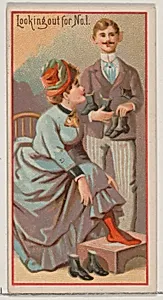
Looking Out for Number One, from the Jokes series (N87) for Duke brand cigarettes
Medium
Commercial color lithograph
Dimensions
Sheet: 2 3/4 × 1 1/2 in. (7 × 3.8 cm)
Classification
Prints|Ephemera
Department
Drawings and Prints
Museum
Metropolitan Museum of Art, New York, NY
Credit
The Jefferson R. Burdick Collection, Gift of Jefferson R. Burdick
Accession Number
63.350.204.81.9
Rights
Public Domain
Art Historical Context
"Looking Out for Number One is a delightful chromolithographed trade card from the Jokes (N87), produced by W. Duke, Sons & Co. in collaboration with George S. & Sons in 1890. This tiny gem, measuring just 2 3/4 × 1 1/2 inches, was tucked into Duke brand cigarette packs as a promotional insert, part of a savvy marketing strategy in the Gilded Age tobacco industry. Duke, a leading American cigarette manufacturer, competed fiercely by including collectible cards featuring humor, sports, and celebrities, turning smokers into avid collectors and boosting brand loyalty. Printed as a commercial color lithograph, the card showcases the era's breakthrough in mass-produced color printing. Chromolithography layered vibrant hues through multiple stone plates, creating eye-catching illustrations affordably for widespread distribution. Its ephemera classification highlights its everyday origins—disposable yet enduring—now preserved in the Metropolitan Museum of Art's Jefferson R. Burdick Collection. These cards offer a window into late 19th-century American culture, blending wit with commerce. The humorous title nods to self-interest, reflecting the era's entrepreneurial spirit and the rise of consumer advertising. A charming survivor of advertising history, it reminds us how everyday objects captured the imagination of a nation on the move.
About the Artist
W. Duke, Sons & Co.|George S. Harris & Sons · 1870–1920
**W. Duke, Sons & Co.: Pioneers of Chromolithographic Trade Card Art** W. Duke, Sons & Co., an American tobacco manufacturer, emerged from the entrepreneurial vision of Washington Duke (1820–1905) and his sons in Durham, North Carolina. After the Civil War, Washington abandoned farming in 1874 to join his eldest son, Brodie L. Duke, in the burgeoning tobacco trade, establishing a factory that for...